
import os import weasyprint html_content = """Team Goldkeys Real Estate InsightsBank of Canada Held at 2.25% — But Two Major Banks Are Calling for Hikes: Brampton & Peel Real Estate

Dated: July 8 2026
Views: 263
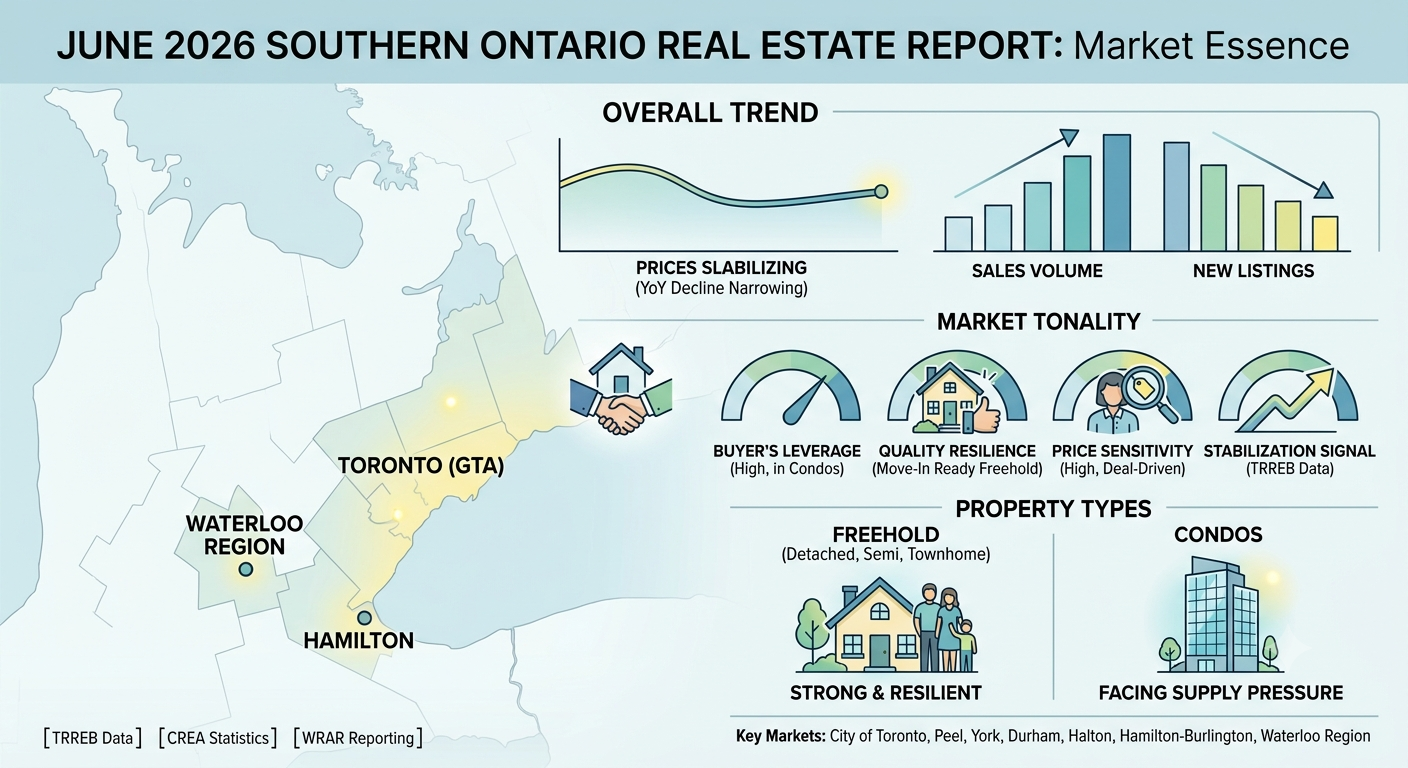
What's really happening across the GTA, Peel, York, Durham, Halton, Hamilton, and Waterloo Region — and how to use it to your advantage this summer.
Southern Ontario entered June 2026 with a clearly more balanced, buyer-friendly tone than the frenetic markets of previous years. Transaction volumes improved, inventory remained meaningful, and prices stayed below year-ago levels across the Greater Toronto Area. But look closer at the data and the pace of price decline is narrowing. Here's what's actually happening on the ground, and how to use this selective recovery to your advantage.
In much of the region, yes — or at least close to a balanced market featuring strong buyer leverage, particularly within the condominium sector and high-supply submarkets. Inventory sat at 4.8 months in May, hovering right near the long-term average of five months. Meanwhile, the GTA saw sales rise 9.4% year-over-year in June while new listings fell 12.9%, a mix that suggests conditions quietly tightened from spring into early summer.
For those tracking the Toronto market, prices were still down on a year-over-year basis in June. The average selling price in the GTA sat at $1,058,658 (down 3.9% year-over-year), and the MLS Home Price Index benchmark dipped 5.4%.
The June 2026 market is best described as a selective recovery: detached homes and move-in-ready properties are finding firm support faster than investor-heavy condos. Buyers remain highly price-sensitive and deal-driven. Sellers who price aggressively and present their homes flawlessly are still commanding attention, while aspirational pricing is being heavily penalized.
The GTA posted a significantly stronger June than the quiet first quarter originally suggested, with 6,770 sales (up 9.4% year-over-year) against 17,282 new listings (down 12.9% year-over-year). Seasonally adjusted data reveals that sales rose from May while new listings fell — a classic sign of a tightening market.
Toronto remains the most expensive and nuanced part of the local landscape. While the overall GTA average price sits at $1,058,658, the City of Toronto's condo market has remained notably softer, with condominium apartment pricing facing a 9.1% year-over-year decline to an average of $618,484. Detached pockets in established central neighborhoods are holding resiliently, but buyers in condo-heavy corridors enjoy excellent negotiating power.
Peel Region — specifically Mississauga and Brampton — continues to reward buyers looking for more space and value. Peel is seeing steady end-user demand, and freehold townhomes have become the absolute "sweet spot," blending family-oriented housing with relative affordability.
York Region (Markham, Vaughan, Richmond Hill, Aurora, Newmarket, and King City) has split in two. Premium, well-located freehold homes are experiencing stable demand and minor price compression, while overly ambitious luxury listings and high-density condos are sitting on the market longer. It remains an excellent region for buyers prioritizing premium school districts, provided they stay patient.
Durham Region (Pickering, Ajax, Whitby, Oshawa, and Clarington) remains the go-to destination for buyers trading commute time for a lower purchase price. In June 2026, local momentum heavily favored semi-detached and detached homes in established family neighborhoods over entry-level condos.
Halton Region remains one of Southern Ontario's most stable ownership markets due to its high household income profiles and long-term community appeal. Buyers are still incredibly choosy: turnkey, beautifully staged homes sell quickly, while imperfect listings see their days-on-market stretch out.
The Hamilton house price narrative for June 2026 is one of balance mixed with pockets of vulnerability. Increased supply and softer demand pressure have given buyers substantial room to negotiate across Hamilton, Burlington, Stoney Creek, and Brantford.
Waterloo Region saw 676 homes sold in June — up a marginal 0.3% year-over-year, but 21.7% below the ten-year June average. The market is functional but far from hot, meaning buyers looking in Kitchener, Waterloo, and Cambridge have plenty of inventory and excellent leverage at the negotiation table.
Where inventory is plentiful, pricing power weakens. Where supply is tight and family demand is stable, prices hold firm.
| Housing Type | Market Tone | Buyer Demand |
|---|---|---|
| Detached Homes | Most resilient segment; down YoY in many areas but strongly defended | Strongest demand from end-user families |
| Semi-Detached | Stable middle ground; softer than peak cycles but well-supported | Solid demand from move-up buyers |
| Townhouses | High-value segment; highly competitive where affordable | Excellent demand from budget-conscious buyers |
| Condo Apartments | Weakest segment; most downward pressure, especially in Toronto | Slower absorption; abundance of choice |
Interest rates, inventory health, and consumer confidence are the three pillars dictating today's prices. Nationally, sales rose 5.5% month-over-month into the summer, tightening the sales-to-new-listings ratio to 49.2%, signaling that buyers are slowly re-engaging as affordability parameters shift.
Underneath the surface, supply constraints persist. Ontario housing starts are projected to dip near two-decade lows due to a sharp pullback in condo pre-construction sales. Policy discussions around development charge reductions highlight how future affordability may improve, though current market activity is driven entirely by present-day consumer sentiment rather than future supply.
Demand hard data and proof of value, refusing to participate in emotional bidding wars.
Are clinging to yesterday's peak pricing, though modern buyers are actively resisting it.
Have stepped away from speculative pre-construction models, shifting focus to cash flow and long-term holding power.
Are currently the strongest segment of the market, moving when pricing and lifestyle align.
Is it a good time to buy or sell in Southern Ontario in July 2026? It depends entirely on your asset class and timeline. For the third quarter of 2026, expect continued tightening across the GTA, a steady but uneven increase in transaction volume, and a narrower year-over-year price gap compared to 2025. Increased competition between buyers is likely in the second half of the year, meaning well-priced freehold properties may see a return to modest price growth. Keep a close eye on whether condo inventories begin to absorb or remain stubbornly elevated through the summer.
Broadly speaking, yes — particularly within the condominium and high-density townhouse segments. However, the drop in new listings throughout June indicates the market is beginning to tighten up moving into the summer.
On a year-over-year basis, they are still down. The June average GTA selling price was down 3.9%, and the HPI benchmark dropped 5.4%. However, month-over-month data shows the pace of these declines flattening out significantly.
Buyers are finding the most room to negotiate in Toronto condo corridors, as well as suburban segments of Hamilton-Burlington and the Waterloo Region, where inventory has outpaced active demand.
Low-rise freehold properties — specifically detached and semi-detached family homes in established pockets of Toronto, Halton, York, and Durham — are performing much better than the investor-exposed condo market.
In a transitionary market like this, the real advantage isn't just access to listings — it's expert interpretation of local data. Manjeet Multani and Arzoo Multani of Team Goldkeys help buyers, sellers, and investors cut through the noise to find real opportunities.
import os import weasyprint html_content = """Team Goldkeys Real Estate InsightsBank of Canada Held at 2.25% — But Two Major Banks Are Calling for Hikes: Brampton & Peel Real Estate
Team GoldkeysPeel Region Real Estate InsightsFall 2026 Seller Strategy Guide · Brampton · Mississauga · CaledonNo Showings After 3 Weeks on the Market? Here's What It Actually
Team Goldkeys · Royal Canadian RealtyBrampton's Detached Market Just Flipped: How Much Over Asking to Offer in Fall 2026 (And When Not To)A data-backed buyer and seller strategy guide for
How Much Under Asking Can You Still Offer in Milton? The September 2026 Negotiating Window, By Price BandExclusively Prepared for Team Goldkeys — Manjeet Multani & Arzoo MultaniCanada;
 Toronto Real Estate Board (TRREB); All information deemed reliable but not guaranteed. All properties are subject to prior sale, change or withdrawal. Neither listing broker(s) or information provider(s) shall be responsible for any typographical errors, misinformation, misprints and shall be held totally harmless. Listing(s) information is provided for consumer's personal, non-commercial use and may not be used for any purpose other than to identify prospective properties consumers may be interested
in purchasing. The data relating to real estate for sale on this website comes in part from the Internet Data Exchange program of the Multiple Listing Service. Real estate listings held by brokerage firms other than Royal Canadian Realty, Brokerage, Mississauga may be marked with the Internet Data Exchange logo and detailed information about those properties will include the name of the listing broker(s) when required by the MLS. Copyright ©2026 All rights reserved.
Last Updated: September 9, 2026 10:46 AM UTC
Show More...
Toronto Real Estate Board (TRREB); All information deemed reliable but not guaranteed. All properties are subject to prior sale, change or withdrawal. Neither listing broker(s) or information provider(s) shall be responsible for any typographical errors, misinformation, misprints and shall be held totally harmless. Listing(s) information is provided for consumer's personal, non-commercial use and may not be used for any purpose other than to identify prospective properties consumers may be interested
in purchasing. The data relating to real estate for sale on this website comes in part from the Internet Data Exchange program of the Multiple Listing Service. Real estate listings held by brokerage firms other than Royal Canadian Realty, Brokerage, Mississauga may be marked with the Internet Data Exchange logo and detailed information about those properties will include the name of the listing broker(s) when required by the MLS. Copyright ©2026 All rights reserved.
Last Updated: September 9, 2026 10:46 AM UTC
Show More...

The listing data displayed is deemed reliable but is not guaranteed accurate by CREA®. Data last updated on September 9, 2026 11:56 AM UTC The trademarks REALTOR®, REALTORS®; and the REALTOR® logo are controlled by The Canadian Real Estate Association (CREA®) and identify real estate professionals who are members of CREA®. Used under license. The trademarks MLS®, Multiple Listing Service® and the associated logos are owned by The Canadian Real Estate Association (CREA®) and identify the quality of services provided by real estate professionals who are members of CREA®. Used under license.
Show More...
 Data provided by the Ontario Regional Technology & Information Systems. The information is deemed reliable, but is not guaranteed. Not intended to solicit buyers or sellers, landlords or tenants currently under contract.
The trademarks REALTOR®, REALTORS® and the REALTOR® logo are controlled by The Canadian Real Estate Association (CREA) and identify real estate professionals who are members of CREA. The trademarks MLS®, Multiple Listing Service® and the associated logos are owned
by CREA and identify the quality of services provided by real estate professionals who are members of CREA. Used under license.
REALTOR® contact information provided to facilitate inquiries from consumers interested in Real Estate services. Please do not contact the website owner with unsolicited commercial offers.
Show More...
Data provided by the Ontario Regional Technology & Information Systems. The information is deemed reliable, but is not guaranteed. Not intended to solicit buyers or sellers, landlords or tenants currently under contract.
The trademarks REALTOR®, REALTORS® and the REALTOR® logo are controlled by The Canadian Real Estate Association (CREA) and identify real estate professionals who are members of CREA. The trademarks MLS®, Multiple Listing Service® and the associated logos are owned
by CREA and identify the quality of services provided by real estate professionals who are members of CREA. Used under license.
REALTOR® contact information provided to facilitate inquiries from consumers interested in Real Estate services. Please do not contact the website owner with unsolicited commercial offers.
Show More...
 All information deemed reliable but not guaranteed. All properties are subject to prior sale, change or withdrawal. Neither listing broker(s) or information provider(s) shall be responsible for any typographical errors, misinformation, misprints and shall be held totally harmless. Listing(s) information is provided for consumer's personal, non-commercial use and may not be used for any purpose other than to identify prospective properties consumers may be interested in purchasing. The data relating
to real estate for sale on this website comes in part from the Internet Data Exchange program of the Multiple Listing Service. Real estate listings held by brokerage firms other than Royal Canadian Realty, Brokerage, Mississauga may be marked with the Internet Data Exchange logo and detailed information about those properties will include the name of the listing broker(s) when required by the MLS. Copyright ©2026 All rights reserved.
Last Updated: September 9, 2026 4:50 AM UTC
Show More...
All information deemed reliable but not guaranteed. All properties are subject to prior sale, change or withdrawal. Neither listing broker(s) or information provider(s) shall be responsible for any typographical errors, misinformation, misprints and shall be held totally harmless. Listing(s) information is provided for consumer's personal, non-commercial use and may not be used for any purpose other than to identify prospective properties consumers may be interested in purchasing. The data relating
to real estate for sale on this website comes in part from the Internet Data Exchange program of the Multiple Listing Service. Real estate listings held by brokerage firms other than Royal Canadian Realty, Brokerage, Mississauga may be marked with the Internet Data Exchange logo and detailed information about those properties will include the name of the listing broker(s) when required by the MLS. Copyright ©2026 All rights reserved.
Last Updated: September 9, 2026 4:50 AM UTC
Show More...
